Introduction
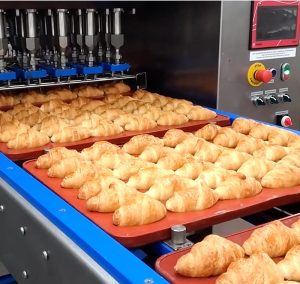
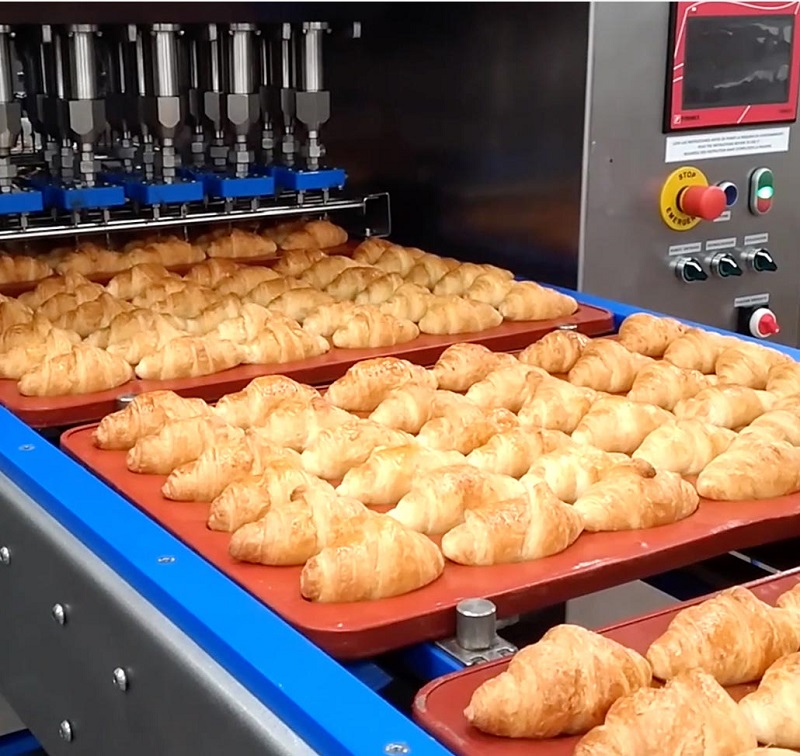
In today’s world, the industrial production of breads and layered pastries such as croissants is growing towards a complete resemblance to handmade croissants but at a high speed. This semi-automatic forming line is a combination of advanced technology and human skill that allows the production of croissants of very high quality and at the same time with high capacity.
Main components of the production line
1. Automatic dough spreader (Sheeter)
Working width 600 to 800 mm
Adjustable thickness from 1 to 40 mm
Hard chrome roller system with precise pressure control
Equipped with roller cooling system to prevent dough sticking
2. Fat injection and laminating unit (Fat Pump & Laminator)
Fat pump with accuracy of ± 1 g / m2
Fat cooling system up to 10 ° C
Capable of injecting butter, margarine or oleogel
3. Multi-Layer Folding Unit
Automatically create 16, 32, 48, 72 or 144 layers
Resting Belt system between stages up to 20 minutes
4. Calibrator unit
Reduces final dough thickness to 3–4 mm
Accuracy ±0.1 mm
5. Triangle Cutter & Curler unit
Precise triangular cutting with a 60 degree angle
Automatic curling system with adjustable speed up to 12,000 pieces per hour
Adjustable curling rate (1.5 to 3 turns)
6. Conveyor and primary fermentation belt
Belt length up to 30 meters
Temperature and humidity control (28 degrees, 80% humidity)
7. Tunnel Oven or Deck Oven
Capacity 2000 to 15000 croissants per hour
Preliminary steam system for shiny crust
Technical specifications of the complete line (model 2024)
Production capacity: 3000 to 18000 croissants per hour
Croissant weight: 30 to 150 grams
Power consumption: 45–110 kW
Space requirement: 12 x 6 m (minimum)
Number of operators: 3–5 people (semi-automatic)
Advantages of this line over the fully automatic line
Texture and layering quality close to handmade
High flexibility in changing weight and shape
Initial cost 40–60% lower
Possibility of producing filled croissants (chocolate, jam, cheese) with small variations
Key points for best quality
Dough temperature always below 16 degrees
Butter or fat must have the same plasticity as the dough
Sufficient rest between lamination stages (at least 10 minutes)
Relative humidity in the stage Final fermentation: 78–82%
Conclusion
This semi-automatic forming line offers the best balance between handmade quality and industrial speed. By investing in this line, you can produce croissants that fully compete with the best European products in terms of volume, layering, crispiness and taste.